

Repetitive Strain Injury (RSI) is a work-related injury that usually (but not exclusively!) occurs in the upper areas of the body. It is commonly found in typists, sportsmen and women, and those who continuously carry out repetitive tasks.
RSI is a particular problem for musicians, as they are especially susceptible while practicing their instrument, often repeating the same part over and over again to perfect their skills.
If musicians develop repetitive strain injury it is crucial that they see their GP or a physiotherapist. If not cared for, the pain is likely to get worse and in particularly bad cases, musicians may have to stop playing completely.
Repetitive strain injuries have already affected the careers of well-known musicians including jazz pianist Jimmy Amade and folk/blues guitarist Leo Kottke. Many more musical careers have been cut short due to a lack of warm up exercises and bad technique – It is important that musicians are aware of how to prevent RSI and what precautions should be taken before even picking up an instrument.
What is RSI?
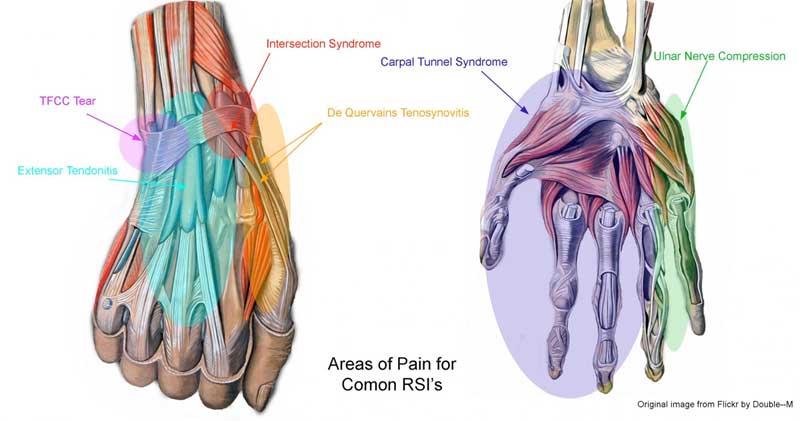
Repetitive strain injury is a general term for pain felt in muscles or tendons while carrying out an activity regularly. It is commonly found in these areas of the body:
- Wrists
- Forearms
- Elbows
- Back and/or neck
The NHS website lists these initial symptoms as:
- Pain, aching or tenderness
- Stiffness
- Throbbing
- Tingling or numbness
- Weakness
- Cramp
At first, the symptoms can be quite mild and easy to ignore. However, without proper treatment and requisite changes to routine, the pain can become more pronounced and prolonged.
The NHS also has some general advice on how to prevent RSI. You can find it on the NHS Website.
Can RSI cause permanent damage?
In most cases, RSI does not cause permanent damage if treated promptly. However, if left untreated and the repetitive activity continues, it can progress to chronic pain that is much harder to manage. In severe or long-neglected cases, there is a risk of lasting nerve or tissue damage. This is why early intervention — rest, physiotherapy, and addressing the root cause — is so important for musicians.
General treatment for RSI
The most important step in treating RSI is identifying the activity that is causing it. For musicians, this will likely be something to do with the way they practice or hold their instrument. Bad technique is a very common cause of RSI.
From there, you may initially be advised to take anti-inflammatory painkillers such as Ibuprofen, as well as using elastic muscle supports with hot or cold packs.
In the long-term, you may be referred to a Physiotherapist for treatment and advice on your injury. There are also Physiotherapists that specialise in musicians’ health problems.
The Musicians’ Union

The MU has all sorts of advice for instrument-specific and musicians’ lifestyle health problems, including RSI. You can find their advice on the MU website or by contacting your local office.
Quick instrument-specific tips to prevent RSI
Violinists
Many violinists develop RSI in their bowing arm due to bad technique. For those with these injuries, it’s always a good idea to focus on keeping a relaxed bow arm and fluid wrist and finger motion. The process of playing the violin should be relaxed – if one spot is tense, RSI is more likely to become a problem.
Musicians should always begin each practice session slowly, warming up first before playing any technically difficult pieces.
Drummers
It is not uncommon for drummers to get RSI, particularly in their backs and wrists. To help prevent injury, drummers should study the Moeller method, which will improve a drummer’s technique, particularly in the way they grip the sticks, sit on the drum stool and hit each drum.
The key to the Moeller method is staying relaxed, and this will help build up the speed of playing without as much risk of developing RSI.
Guitarists
Guitarists tend to contract repetitive strain injuries in their fingers and should use finger exercises both on and off the guitar to prevent injuries. Finger exercises should aim to stretch the fingers and build up the muscles. At the end of a practice session, fingers should not feel sore.
The height of the guitar can also have a dramatic effect on a guitarist’s technique. A low-slung guitar, whilst perhaps looking ‘cool’, can lead to bad technique and eventually RSI.
Can you play guitar with RSI? Many guitarists do continue to play with mild RSI, but it’s important to reduce playing time, address technique issues, and seek advice from a physiotherapist. Ignoring the pain risks turning a short-term issue into a long-term one.
One guitarist that definitely needs to have a good warm up routine is blues-rock legend, Joe Bonamassa. He details his warm up in this video:
Pianists
Poor posture and bad technique has resulted in many pianists getting RSI. Whilst the usual processes of warming up will help prevent injuries, various pieces can be more challenging, especially for pianists who are inexperienced.
Can you get RSI from playing the piano? Yes — pianists commonly experience forearm and wrist pain from repetitive movement. The condition is sometimes referred to as ‘non-specific upper limb pain’ or ‘work-related upper limb disorder’. Considering this, it is important that pianists have the manual strength and technique to perform demanding repertoire such as Bach or Prokofiev, and that they build up gradually rather than overreaching.
How to avoid tendonitis as a pianist: warm up thoroughly, keep sessions to a sensible length, avoid tension in the shoulders and wrists, and consider the Alexander technique to improve your overall posture and movement patterns.
Top tips to prevent RSI
- Take regular breaks when practising — aim for a 10-minute break every 45–60 minutes
- Consider using the Alexander technique to improve posture and movement efficiency
- Use warm-up and cool-down exercises before and after playing
- Improve your posture — sit or stand correctly and keep your instrument at the right height
- Try to stay relaxed when playing; tension is one of the biggest contributors to RSI
- If you feel pain, stop playing and seek professional advice — do not push through it
Looking for work as a musician? Read our guide to getting well paid gigs — and make sure you’re in good physical shape to take them!
Sources
- Patient.info – Repetitive Strain Injury
- NHS – Repetitive Strain Injury (RSI)
- David O. Romaner – 10 Tips for Drummers with Repetitive Injuries
This article was last reviewed and updated in February 2026.