Gypsy Swing Bands for Hire

Hire a gypsy jazz band and bring the sound of Django Reinhardt and the hot club of 1930s Paris to your wedding, drinks reception or event. Browse 61 acts below, from intimate guitar and violin duos to five and six-piece manouche line-ups with double bass, and compare audio and video samples alongside 541 reviews rated 5 out of 5 by real clients. Prices start around £100 for a duo, with an average of £803 depending on the size of the line-up and how far the band travels.

Gypsy jazz suits weddings, garden parties, corporate functions and vintage or 1920s-themed events, working equally well as relaxed background music during a drinks reception or as an upbeat set to get guests dancing later on.

Rated Excellent (5/5) from 541 reviews of Gypsy Swing Bands
Klezmer and gypsy swing at its best!

5 reviews

Glasgow, Lanarkshire

Book from £1029 - get a quote

Add to favourites

Showing 61-61 of 61 results
Rated Excellent
TrustPilot 5 Stars

Browse categories similar to Gypsy Swing Bands

How much does it cost to hire Gypsy Swing Bands?

£ Low Price
from
£100
££ Average Price
from
£803
£££ High Price
from
£3250
The average price for Gypsy Swing Bands is £803. Above you will also find a budget price and high end price. Contact the act you like for an accurate quote.

Frequently asked questions


As a general guide, a 3-piece band needs a performance area of roughly 3m x 3m. Add approximately 1m of width for each additional musician. A 5-piece band would therefore need around 3m x 5m as a minimum. Most bands will also need a small amount of additional space at the sides or rear for equipment cases during the performance. A raised stage is not essential but does help the band make a bigger visual impact, particularly in larger rooms. The performance area needs to be flat, dry and close to a power supply. If you are unsure whether your venue can accommodate a particular band, share the dimensions with them when enquiring and they will be able to advise. Venues with unusual layouts or low ceilings are worth flagging too.

Most professional bands provide a playlist through their PA system during intervals, so there is no gap in the music and no awkward silence while they take a break. This is usually included as standard and the band will typically put together a playlist that fits the mood of the evening. Some acts offer an upgraded DJ service where a member of the band or a dedicated DJ manages the music between sets, takes requests and keeps the energy going. This is usually available as a paid add-on. Check the act's profile or ask when enquiring if this is something you would like.

In most cases, no. The majority of professional bands provide music through their PA system during intervals and after their final set, so your guests will have continuous music throughout the evening without needing a separate DJ. This is usually included in the booking. If you want a more interactive DJ experience, with someone to take requests, mix tracks and keep the dancefloor going after the band finishes, many bands offer this as an optional upgrade, or you can book a DJ separately. It is worth deciding early how late you want music to continue, as a band's final set will typically finish by midnight or the venue curfew, and a DJ can be a cost-effective way of extending the night.

Professional bands take their commitments seriously and cancellations are rare, but illness, accidents or unforeseen circumstances can occasionally affect a booking. It is worth checking what provisions are in place when you book. Many acts and agencies have contingency arrangements, such as calling on dep musicians or arranging a suitable replacement act at short notice. When booking, make sure you receive a written contract that sets out the cancellation terms clearly, for both sides. If you are booking through an agency, ask specifically what happens in the event the act cannot perform. Keeping communication open with your band in the weeks before the event also helps flag any potential issues early.

Band size affects both the sound and the budget. A 3-piece can fill a dancefloor just as effectively as a larger act and tends to be better suited to smaller venues or those with sound restrictions. A 4 or 5-piece gives a fuller sound and more stage presence, which works well in larger rooms. Bigger show bands with brass sections, multiple vocalists or additional musicians create a more spectacular impact but cost more and need more space. As a rough guide, match the band size to your guest numbers and venue capacity. For events up to around 100 guests, a 3 or 4-piece is usually ideal. For 150 or more, a 4 or 5-piece tends to work better. For very large events over 300 guests you may also need to consider whether the band's own PA system is sufficient, or whether additional sound equipment will be needed.

Booking gypsy swing bands as early as possible increases the chance of securing their availability on your event date, particularly during busy times of the year. However, many acts also accept last minute bookings, and we have successfully arranged performances for clients with just a few hours' notice.

The cost of hiring musicians can vary significantly depending on the type of act. The average price is currently £803. Budget-level acts may be available for as low as £100, while top-tier acts can command prices as high as £3250.

A gypsy jazz band plays the acoustic swing style developed in Paris in the 1930s by guitarist Django Reinhardt and violinist Stephane Grappelli with the Quintette du Hot Club de France. The sound is built on acoustic guitars, with one leading the melody and one or two others driving the rhythm, usually joined by a double bass and often a violin or clarinet. It is one of the few live band styles that is genuinely acoustic. There is no drum kit and often no amplification at all, which gives it a warm, unobtrusive character that suits drinks receptions, dinners and venues with strict noise limits. The style is also known as gypsy swing, jazz manouche or Hot Club jazz, and acts on this site may describe themselves using any of those names.

There is no real difference. They are two names for the same style, along with jazz manouche and Hot Club jazz. Gypsy jazz is the term most commonly used in the UK and the one most people search for, while gypsy swing tends to be used where the emphasis is on the danceable, up-tempo end of the repertoire. If you are comparing acts, do not read anything into which name a band uses to describe itself. What matters more is the line-up and the repertoire: whether there is a violin or a clarinet, whether the band sings or plays purely instrumentally, and how far beyond the Django Reinhardt songbook they are willing to go. Those differences are far more noticeable at an event than the label.

The core repertoire is the Django Reinhardt songbook and the jazz standards of the 1930s and 1940s: Minor Swing, Nuages, Djangology, All of Me, Sweet Georgia Brown and similar material. Most bands also play French musette waltzes, which give the style its distinctive Parisian character, and a selection of bossa nova and Latin-flavoured numbers. Beyond that, most acts carry arrangements of well-known songs from later decades reworked in the gypsy jazz style. The repertoire is largely instrumental, though many bands include a vocalist or a singer who joins for part of the set. If you want a particular balance between instrumental and sung material, or a set weighted towards the up-tempo end, say so when enquiring, as this varies a lot between acts.

Yes, and most do. Gypsy jazz arrangements of modern pop songs are common and often work better than people expect, because the style is built on chord progressions and improvisation rather than on a fixed arrangement. Songs by Amy Winehouse, Ed Sheeran, Daft Punk and others have become standards of the modern gypsy jazz repertoire. If you have particular songs in mind, including a first dance, most bands will learn them given reasonable notice, ideally six to eight weeks. Some songs adapt more naturally than others: anything built on a strong chord sequence usually translates well, while a track that depends on production or a heavy beat may need substantial rearranging. A good act will tell you honestly which category your song falls into.

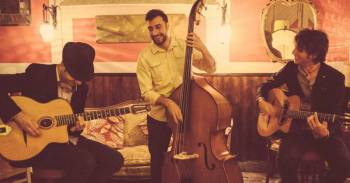
The classic line-up is two or three acoustic guitars and a double bass, with one guitar playing lead and the others providing the rhythm known as la pompe. A violin is the most common addition and gives the sound its recognisable lift. Clarinet, accordion and occasionally saxophone also appear, and some bands include a vocalist. Sizes usually run from a duo up to a five-piece. A duo of guitar and bass, or guitar and violin, works well for background music in a small room. A trio is the most popular size. A quartet or quintet gives more variety across a longer booking and more soloists to share the improvising. Tell the act the room size and the kind of atmosphere you want and they will suggest a line-up.

Gypsy jazz is one of the most popular wedding choices for the earlier parts of the day. It suits guest arrival, the drinks reception and the wedding breakfast particularly well, because it is acoustic, unobtrusive and adds atmosphere without making conversation difficult. Many couples book it for the afternoon and a louder band or a DJ for the evening. It can also work for the whole day. A larger line-up playing up-tempo material will hold an evening, though it will not fill a dance floor in the way a function band does. If you want a gypsy jazz first dance followed by dancing, discuss it with the act, as some will bring a percussionist or amplify for the evening while others prefer to stay acoustic throughout.

Often not, and this is one of the style's real advantages. A gypsy jazz trio playing acoustically will comfortably fill a room of around 60 to 80 guests with no PA at all. For larger rooms or noisier events the band will use light amplification, but the overall level remains far below that of a band with drums. That makes gypsy jazz one of the best answers for venues with a sound limiter. There is no drum kit, which is what usually trips a limiter, and no bass amplification to speak of, so the low frequencies that cause most of the problems simply are not there. Many acts have played venues where louder bands have been cut off mid-set. Tell the band the decibel limit anyway so they can plan.

This is what the style does best. Because it is acoustic and there is no drum kit, a gypsy jazz band can play at genuine background level while people eat and talk, and then lift the energy when the moment calls for it. It is one of the few live options that does not force a choice between having music and being able to hold a conversation. Most acts will happily play a long, low-key set rather than two concentrated blocks, which suits a drinks reception running into a meal. Speak to the band about volume expectations in advance and about where they will sit, as placement matters more with an acoustic act than with an amplified one. A corner of the room rather than a stage usually works best.

Yes, though it is a different kind of dancing to a function band. The up-tempo end of the repertoire, particularly the swing and jive numbers, is genuinely danceable, and gypsy jazz is popular at lindy hop and swing dance events. A band told in advance that dancing is the aim will weight the set accordingly and play at the tempos dancers expect. If a packed dance floor is your main priority for the evening, a function or soul band will do that more reliably, since the acoustic volume and the largely instrumental repertoire suit listening better than late-night dancing. Many couples get the best of both by booking gypsy jazz for the day and something louder for the evening. Say what you want from the booking and a good act will be straight with you.

Most gypsy jazz bands bring their own instruments and, where amplification is needed, a small PA suited to an acoustic act. That is usually far less equipment than a standard band, often no more than a couple of small speakers, microphones and stands. Some purely acoustic acts bring nothing beyond their instruments and chairs. Because the footprint is so small, setup is quick and access rarely presents a problem, which makes these acts practical for venues with awkward stairs, listed buildings or tight rooms. Tell the act the room size, guest numbers and whether the space is carpeted, as soft furnishings absorb an acoustic sound noticeably. If the venue has its own system, mention it, as many bands can use it rather than bringing their own.

A typical booking is two or three sets of around 45 minutes across a two to four hour window. Because the style is acoustic and less physically demanding than a full amplified set, gypsy jazz bands are often more flexible about playing across a longer part of the day than louder acts are, and three shorter sets spread across an afternoon is common. Between sets, most acts will provide recorded music if they have a PA with them, though a purely acoustic band may not. Ask about this if you want continuous sound, as it is one of the few practical trade-offs of booking an unamplified act. Agree the finish time with your venue first, as the curfew usually decides it.

Yes, and gypsy jazz suits outdoor events better than most live music, since there is little equipment to protect and no need for a large power supply. Shelter is still important, because acoustic guitars and a double bass are wooden instruments that react badly to damp and to direct sun, so a covered area is needed rather than optional. The main limitation is volume. An unamplified acoustic band carries poorly in open air with nothing to reflect the sound, so for anything beyond a small garden gathering the act will want light amplification. Tell them the setting and the guest numbers when booking. A marquee, terrace or courtyard usually works better than an open lawn, both for the sound and for the instruments.

Gypsy jazz is a strong corporate choice, particularly for drinks receptions, awards dinners, gallery openings and networking events where the brief is atmosphere rather than entertainment. It reads as sophisticated without being formal, and the acoustic volume means guests can talk over it without raising their voices, which is usually the point at a business event. For private parties, it suits milestone birthdays, anniversaries and garden parties, and it works particularly well for events in unusual venues where a full band would not fit or would not be permitted. Themed evenings with a Parisian, 1920s or vintage feel are common bookings too. Tell the act about speeches or presentations so they can plan their sets around them.

Frequently asked questions about Gypsy Swing Bands, how to register and how results are ordered are in the help & FAQs.

Hire Gypsy Jazz Bands in the UK

Gypsy jazz, also known as jazz manouche or hot club, is the swinging acoustic style pioneered by guitarist Django Reinhardt and violinist Stephane Grappelli in 1930s Paris. Built around nimble acoustic guitars, a driving rhythm and soaring violin or clarinet leads, it is a distinct sound from a full jazz band and from the brass-led swing bands of the big-band era. If you want that unmistakable Hot Club de France feel, this is the category to book from.

The Django Reinhardt sound

The repertoire leans on manouche standards such as Minor Swing and Djangology alongside jazz classics and the occasional pop tune reworked in a gypsy swing style. The music grew out of the French musette and chanson tradition, so many acts sit comfortably next to a French-style band at a Parisian-themed event. Rooted in Romani heritage, the style trades horns and drums for the interplay of rhythm and lead guitars, which is what gives it that light, dancing momentum.

Line-ups and what to look for

Gypsy jazz acts range from an intimate guitar and violin duo, ideal for a ceremony or a small room, up to a five or six-piece with double bass, second guitar, accordion or clarinet for a fuller sound. Because line-ups vary so much, watch each act on video and listen to their audio before you book, and tell the band your guest numbers and venue size. The music was traditionally played acoustically and often still is, which suits quieter spaces beautifully, though most acts can add light amplification for larger rooms or outdoor settings.

Where gypsy jazz works best

The style is a natural fit for weddings, garden parties and vintage celebrations, and it makes elegant background music during a drinks reception or wedding breakfast before the dancing starts. It is a favourite for 1920s, Gatsby and Prohibition themes, so it pairs well with era acts such as 1920s, 30s and 40s style bands. For a wider search, browse all wedding musicians to compare options side by side.

How much does it cost to hire a gypsy jazz band?

The average cost of a gypsy jazz band is £803, though what you pay depends on the size of the line-up, how long you need them to play and how far they travel to your venue. A guitar and violin duo is the most affordable option, while a full manouche ensemble sits at the higher end. Compare current prices for every act using the price comparison section on this page.

Hire live Gypsy Swing Bands
View Favourites